Sign Your Art so People Can Read It... and Other Tips
Artist Signature Identification from Artbusiness.com >>Signing your art is an integral part of the creative process. The instant you apply your name to a piece of your art, you declare that art officially finished and ready for public exposure. No matter what your signature looks like, what form it takes or where you put it, no work of your art is complete without one.
Your signature identifies your art for all time as having been created, completed, and approved of by you and you alone (with the exception of collaborative works, of course). When someone wants to know who created your art, your signature tells them. When someone sees your art for the first time and wants to know who the artist is so that they can see more, your signature helps them find you. When you're not around to identify your art (and sooner or later you won't be), your signature identifies it for you.
Far too many artists treat signing their art as little more than an afterthought or inconsequential incident, like signing a check or a credit card receipt. But dismissing the importance of your signature and the moment of signing can lead to all sorts of problems later in a work of art's life. This is especially true the better known or more famous an artist eventually becomes.
The most serious signature problem? No signature. Believe it or not, a significant percentage of artists these days don't even bother to sign their art. Why? Maybe they think their work is so identifiable that everyone automatically knows who did it. Maybe they think everyone knows who they are. Maybe they think everyone will continue to know who they are for all eternity. Well guess what? Maybe they're wrong. So rule number one-- by far the most important rule-- sign your art. Period.
The second most serious signature problem? Names so illegible that the only people who can identify them are those who already know the artist... because they're the only ones who can recognize the signature when they see it (they can't actually read it; they just know what it looks like). Anyone outside the immediate inner circle is pretty much screwed. So rule number two-- sign your name so that people can read it. To repeat: Sign your name so that people can read it. You don't necessarily have to sign legibly on the front of the art, but make sure you clearly sign or otherwise label or identify your art as being by you-- somewhere, anywhere-- as long as it's on or attached to the art.
Artists sign their names illegibly for a variety of reasons, similar to those who don't sign at all. Some think it looks good, some do it to impress people, others think their work will always be identifiable as theirs whether or not anyone can read or recognize their names, still others feel that an unreadable signature has a mystique about it, an only-special-people-can-read-it quality. Maybe, like with artists who don't sign at all, they're so over-infused with hubris, they actually believe that no one will ever forget who they are or ever question who made their art. The truth about that? Nothing is further from the truth.
Here's a signature example for you... care to take a guess?
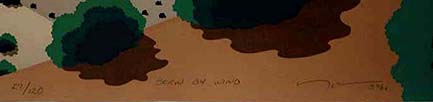

To begin with, so many artist signatures (of all time periods) are difficult or impossible to read that they've become a significant problem in the marketplace and identifying them, an industry in and of itself-- so much so that there's even a book about them. Author and art researcher John Castagno wrote Artists' Monograms and Indiscernible Signatures, An International Directory, 1800-1991, containing over 5,000 such examples, and it's not even close to being comprehensive. FYI, I actually offer a service where I charge a fee to identify indecipherable signatures (and only charge if I make positive identification-- which sometimes I do, but many times I don't). If artists had any idea what happens to art with signatures that can't be identified by using Castagno's book, searching randomly online, lucking out and finding someone who just happens to recognize the art, or enlisting identification services offered by people like me, a lot fewer signatures would be deliberately incomprehensible.
How does art lose its identity? You as an artist should be aware that people buy art all the time and never tell anyone who the artist is. People buy art all the time and forget who the artists are. People sell, donate, transfer or otherwise give away art all the time, without ever informing the new owners who the artists are (assuming they even remember), for instance, when they move or downsize their residences, redecorate, or when they just plain get tired of looking at it. Art also loses its identity when it changes hands through death, divorce, inheritance, barter, as gifts, and so on.
In fact, here's a perfect example of what I'm talking about. Let's say someone buys a piece of art with an illegible signature for a hundred bucks at an artist's first show just because they like it and can afford it (the artist, of course, is a complete unknown). A few years later, that buyer is moving or his tastes have changed or whatever, so he gives the art to an acquaintance because she likes it. It's new owner doesn't ask who it's by, doesn't really care, and he doesn't bother mentioning who did it (assuming he even remembers) because after all, he got it cheap, right? The artist was a nobody, right? Right. Now let's say that it's 20 years later, the artist is famous, and that piece of art is now worth $100,000. You beginning to get the picture? Hey-- it happens-- and it happens a lot more often than you think.
Whenever a work of art ends up in circumstances where nobody knows, remembers, or can identify the artist, and nobody really likes or cares about it all that much (forget about how good it may be from a critical perspective or how famous the artist might be), it ends up at flea markets, garage sales, auctions, the Salvation Army, Joe's Maison de Junk, in the garbage, in the fireplace, garages, attics, gathering mold in basements or outbuildings, getting crammed into storage lockers, protecting barbeque grills from the rain, or becoming toys for little Billy-- you name it.
Do you want to jeopardize your art's future simply because people have difficulty reading your signature? I doubt it. And don't think that just because you're known in certain circles-- or even nationally or internationally for that matter-- that your art is safe forever. Not even art by the most famous artists in the world is identifiable by everyone. Wayward works of art by famous artists are rediscovered all the time, and do you know the main reason why? Because luck has it that someone somewhere with adequate knowledge of what they're looking at can identify either the styles of the art or their signatures and rescue them. And in all the rest of the cases where no guardian angel comes along, that art is off to oblivion. The moral of the story is that you can sign your name as inscrutably as you want and wherever you want as long as you also clearly identify yourself as the artist elsewhere on the art. Or risk the consequences.
Additional pointers for signing your art:
* Art by artists who sign with initials, monograms, and symbols often meets similar fates to illegibly signed art. Here again no matter how infatuated you are with your fabulous handle, clearly sign or otherwise identify yourself elsewhere on your art.
* Sign your art in the same medium in which you create it (except for graphics or limited editions, which are generally signed in pencil). For example, sign a watercolor in watercolor, an acrylic in acrylic, and an oil painting in oil paint. When you sign in a different medium, you increase the chances of someone will eventually question whether or not the art was actually done by you. Hey-- it happens all the time.
* Placing your signature or monogram into the compositions of graphics or limited editions (signing in the plate or composition) in addition to signing them by hand provides extra means of identification and can also "brand" your work or even protect it against people who try to copy it.
* Sign all of your art in pretty much the same way. Signatures should be consistent in size, coloration, location, style (written or printed), and other particulars. That way, people who aren't necessarily familiar with all the styles of art you've produced over your entire career will at least be able to recognize your signature, and therefore identify it as being by you. Also, signing your name in many different ways or locations eventually makes it easier for forgers to sign fakes in various ways and claim they're by you.
* Date your art. You may not think this is important now, but after you've been making art for several decades, you'll understand why. If you don't want to date your art on the front, date it inconspicuously on the back-- or even on the edge. Obviously, dating your art minimizes any guesswork as to when something was completed. The better known you become, the more important dates are for anyone interested in your evolution as an artist... and that includes those who'll be curating your retrospectives.
* If you make works on paper, you may want to use an embossing stamp or even a fingerprint in addition to your signature, thereby making the act of completion more formal and official. Art with your signature and a stamp or a fingerprint is also more difficult to replicate, forge or copy.
* Sign your art as soon as its done, preferably while the paint or clay or whatever medium it's in is still wet or pliable. Collectors prefer signatures that are "embedded" in the art because those types of signatures are the most difficult to forge or duplicate. Furthermore, the closer you sign to the moment of completion, the more you're in the "zone" in which you created the art, and the more unified and harmonious the signature is with essence of the art. The longer you wait to sign, the less the signature tends to match the overall tone or import of the piece.
* Don't sign on top of a varnished painting or completed sculpture because the signature then looks like it was added later, more as an afterthought than a declaration.
* Your signature should not be so bold or overbearing that it actually interferes with or detracts from the composition unless you purposefully intend for that to be a consistent characteristic of your art. It should blend rather than contrast or conflict with its surroundings and look like it "lives" within the art.
* Don't scratch your signature into dried paint, ceramic, or similar media unless this is how you normally sign. Scratched signatures rarely blend with their art and their authenticity can also easily be questioned.
Remember, you're not always going to know where every piece of your art is or where it's journeys will end. And you certainly won't be around for all eternity to vouch for it. Those who buy your art today will not necessarily own it tomorrow (or even remember that you were the artist). Regardless of where your art ends up or who eventually owns it, make sure that it will be treated with care and respect at all times, and never relegated to the "I don't know" pile. By taking the signing your art seriously, you maximize the chances that people will be able to identify and remember you through your life's work for generations to come.


 Subscribe to Mag+ blog

